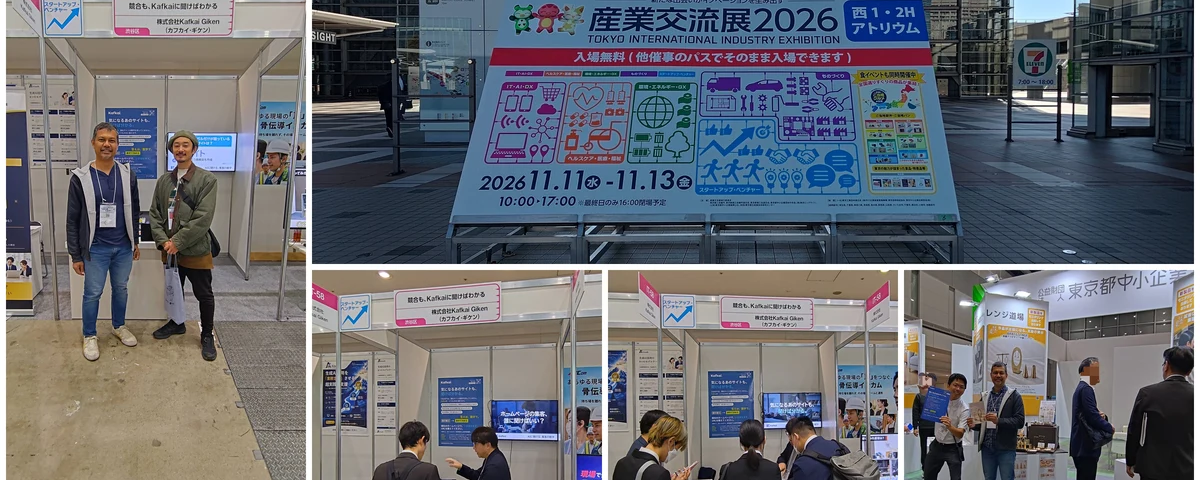
For three days, from Wednesday 11 to Friday 13 November 2026, we exhibited at Sangyo Koryuten 2026 (産業交流展2026), the Tokyo International Industry Exhibition, at Tokyo Big Sight. The show gathers about 600 companies and organisations across about 800 booths, mostly small and medium-sized companies and startups in the Greater Tokyo area, and they fill the booths with products and services. Kafkai's booth was IT-58, in the IT, AI and DX zone.
As we said in the exhibition announcement, the only thing we showed was Kafkai Ver.4. Under the line on our sign, "Ask Kafkai, and your competitors become clear too", Yatomi, our producer, and I stood at the booth.
What Visitors Asked at the Booth
The most common question was, "Can I use this on my own site?" One visitor, for example, had a site built on a service other than WordPress. It works whatever the site is built with. With Kafkai's data behind it, an AI agent will go as far as proposing "fix this page" or "write this article". If the site runs on WordPress, the agent can take the article through to publication, and that was the part visitors found most interesting.
A visitor who runs an online store asked about the Amazon and Google Shopping ranking check we published on 11 November. It is a feature that lets you ask an agent where your product ranks, and which products sit above yours and at what price. It was the first day of the show, and the question came the same day we published it, which made me happy.
Pricing came up often as well. Kafkai is not a monthly subscription. You pay for what you use. It also connects to Google Analytics 4 and Google Search Console, so you can see how the ranking and the traffic of an article published last week have moved.
One visitor also asked, "Is the name taken from Kafka, the open source project?" The answer is the writer, Franz Kafka.
Colleagues from the Chamber of Commerce Came By
I belong to the youth division of the Tokyo Chamber of Commerce and Industry, Taito branch. This time I met two of my colleagues from it at the venue.
The first was Ichikawa-san, who runs the flower shop SANT JORDI in Sanya, Taito ward. He came to the booth on the first day. There was also a keynote that day, given by the astronaut Soichi Noguchi, who is the ambassador for the show. The title was "Space business opened up by Artemis and SpaceX", and Ichikawa-san came to hear that too.
The second was Tokuhara-san, representative director of Tokuhara Kogei. The company is in Kita-Ueno, Taito ward, and handles more than 7,000 kinds of accessory parts, mostly brass. This time they were at the Tokyo Metropolitan Small and Medium Enterprise Support Center booth, showing BRASS STAGE, a new brass fixture for displaying accessories. The photo shows the two of us at that booth, showing each other our flyers.
The Networking Session and Other Exhibitors
After the first day closed, the exhibitors held a networking session. The organisers gave everyone a coloured tag and set it up so that you talk to other attendees, collect ten colours, and join a prize draw. That got the whole room walking about and approaching strangers first, and I enjoyed it. I visited the booths of the people I exchanged cards with over the following two days. I also met several people who are working with Malaysian companies to bring Malaysian products into Japan.
KOTOBUKI Advisory, "TSUBASA"
I went to KOTOBUKI Advisory LLC after talking with its representative, Sumie Fujimura, at the networking session. What they had on show was TSUBASA, a strategy co-creation platform. The management team works through six modules in order and builds its own growth strategy. AI organises the material for each module and puts the questions to the team. The discussion itself is run by a facilitator certified in TSUBASA. You choose either the one-week intensive format or one session a week for a month, and finish with a 90-day execution plan.
The AI asks the questions, and people discuss them. I found that split easy to follow. TSUBASA works with the knowledge inside the management team, while Kafkai brings information from outside, which is search data. Put the two together, and there is more material for the discussion.
Fairground, "Tonari no AI"
Fairground is a web production and editorial company in Shibuya. I exchanged cards with its representative, Kobayashi-san, at the networking session. At the booth I heard from Kamoto-san, a producer, about Tonari no AI, a service that automates the repetitive work of a small company with AI.
There were two demos. The first judges how important an enquiry is. AI reads enquiries that arrive by phone, chat or email, grades them, and notifies Slack or Teams. The grading rules are set in a prompt, they said. The second drafts sales emails. Enter the target company's name and the URL of its website. The AI works out the prospect's problems and what you can offer against them, then writes the subject line and the body. A person always checks the draft before it goes out.
Fairground also works on SEO and content production, so the conversation went as far as Kafkai's data being useful when they decide whether to prioritise new articles or rewrites.
mile, "Wash on Go"
At the booth of mile Inc., director Watanabe-san was presenting the laundry service Wash on Go. An Uber Eats delivery partner comes to your hotel to collect the laundry, and it comes back washed and folded. Prices start at 6,980 yen, tax included, for up to 6 kg. Most users are foreign visitors on long stays, and the service covers Tokyo, Osaka and Kyoto.
After the Show
To be honest, about 15 general visitors came to the booth over the three days. That is not a large number.
What mattered most this time was still the connection with other exhibitors. When I walked over to their booths, they came to ours. Apart from those 15, I exchanged cards with around 50 people over the three days.
What mattered more than the number was the content of the conversations. It was not hand over the card and done. I heard about the other person's business at length, we put each other's management problems on the table, and we got as far as swapping ideas. That is the biggest difference from the shows I have exhibited at before.
The booth also took sign-ups for a free site analysis for visitors. Scan the QR code, enter your site's URL, and we send three things together.
- Which keywords your site appears for in search
- Which sites are competing with you in search
- Which keywords and article themes you are missing compared with those competitors
Several visitors signed up on the spot. We will send the results by email after the show.
In April, at SusHi Tech Tokyo 2026, the conversations were mostly with visitors from overseas and with VCs. At Content Tokyo 2025, 38,840 people came over three days, and the booth was mostly demos and setup consultations. This time, the conversations were mostly between small companies in Tokyo. Most of Kafkai's customers are companies of three or four people, and many of the exhibitors I spoke to were about that size as well. Because our companies were similar in size, our problems were similar too, and the conversations went deeper.
Thank you to everyone who came to the booth, and to every exhibitor who spoke to us. If we did not get to talk at the venue, please write to [email protected].
Related Articles
- Sangyo Koryuten 2026: Kafkai Ver.4 at Booth IT-58
- Kafkai Ver.4: Ask Your AI About Any Site Over MCP
- Kafkai Adds Amazon and Google Shopping Rankings
- SusHi Tech Tokyo 2026, Day 2: Startup Expo Report
- CONTENT TOKYO 2025 Exhibition Report: Kafkai Booth
- Business Chance EXPO in TOKYO 2024: Kafkai's Report