

Kafkai Ver.4 is live.
In August I wrote that a major update was coming and the current Kafkai would become Legacy. This post is the other half of that announcement. It answers three questions: what Ver.4 is, what changes, and why we did it.
The short version: Kafkai no longer asks you to log in and click through screens. It connects to the AI you already use, such as ChatGPT or Claude, and your AI asks Kafkai for the data. You type a question about a site in any language that you usually use. Your agent calls Kafkai, gets the real search numbers, and answers you.
What Ver.4 Is
Kafkai Ver.4 is a data source for your AI agent.
The core has not changed. It is still the patented method that pulls the search data of your site and your competitors' sites and sorts every keyword into the 4C framework: Compete, Catch-up, Consolidate and Complement. That is the part only Kafkai can do, and it is Japan Patent No. 7701764.
What changed is where that data goes. In Ver.3, the data went to a dashboard, and you read it. In Ver.4, the data goes to your AI agent, and the agent reads it for you.
The connection uses MCP, the Model Context Protocol. If you have not heard the term, think of it as a plugin for your AI (I wrote a short, slightly technical explaination in my article Introduction to MCP). Every customer I showed Ver.4 to in September needed this explained first, so here it is in one paragraph:
You add Kafkai once in your agent's connector settings. From then on, when you ask your agent something that needs search data, the agent calls Kafkai, gets the numbers, and works from them. Your question goes in through your agent. The answer comes out of your agent. Kafkai works behind it, and you never open a Kafkai screen to get it.
The direction matters, because one customer pictured it backwards. It is not Kafkai sending your request to ChatGPT. It is you, then your agent, then Kafkai, then the data sources. Kafkai holds no AI of its own in this flow. Your agent thinks and writes with whatever model you already pay for.
One prospect summed it up during a demo before I had the words for it. When they saw a draft go from the conversation, through Kafkai, to a WordPress site, they said Kafkai becomes the hub. That is the design.
What You Can Ask
Ver.4 works for any site: your own, a competitor's, a client's, or one you are curious about. The questions that come up most often look like this.
- What does this site rank for, and what do its competitors rank for that it does not?
- Who links to my competitors, and which of those sites do not link to me?
- Who am I competing with in search? I do not know my competitors yet.
- What changed in my Search Console this week?
- Which of my old articles should I fix before I write a new one?
- What should we write next?
Each answer comes back inside the conversation, as a list, a table, a chart or a report. You decide the shape by asking for it.
What Changes
Ver.4 is not Ver.3 with a new look. Six things are different, and two of them remove something you may have relied on.
1. Your AI Reads the Data. You No Longer Have To
This is the change that made a Ver.3 customer say, at the end of our meeting, that they would try it after all.
Ver.3 gave you the data and left the reading to you. That was fine for a company with a person whose job is to read keyword tables. Most of our customers do not have that person. On one call this month, a store owner told me the most important input for their content, the keywords, had come from an outside consultant, and the Kafkai data they paid for went mostly unused. They put it plainly: they never got to use the good parts.
In Ver.4 the agent is that person. Ask "which keywords should I go after first, against these three competitors?" and the agent reads the 4C data, weighs volume against difficulty, and gives you a short list with reasons. The table is still there if you want it. You just do not have to start from it.
2. More Data Than Ver.3 Had
Ver.4 supplies data that Ver.3 never did.
- Backlinks. Which sites link to your site and to each competitor, how strong those sites are, which links are new and which were lost. One question that convinced an AI-literate prospect: which of a competitor's links come from junk domains. A free AI cannot see that at all.
- Link gaps. Sites that link to two or more of your competitors and not to you. That list is where link building starts.
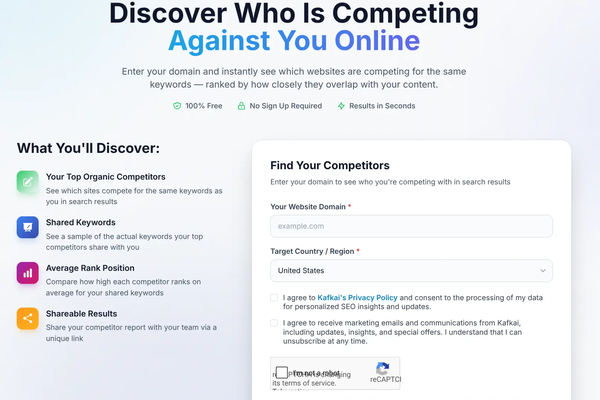
- Competitor discovery. Give Kafkai your domain, and it names the sites that rank for the same keywords you do, closest first. You do not have to know your competitors before you begin.
- Google Search Console (GSC). Connect it once, and your agent can answer "what changed this week" without you learning where to look in Search Console.
- Google Analytics 4 (GA4) and optionally Kafkai's own analytics. Your traffic, read live, so the agent can connect what you published to what happened after.
- History. Every refresh keeps the previous snapshot. After three or four months you can ask what moved: which keywords rose or fell, how many links each site gained or lost, and which competitor is building links fastest.
History was also something that the previous version of Kafkai had, but in a form which was not flexible. You can now have it generated in any graph or data form which you AI agent is capable of.
Search Console and analytics data are served only for a domain you have verified. You prove control by publishing one DNS TXT record, or a meta tag, once. That is on purpose. Kafkai will not show one customer's Search Console data to another, and a domain name alone does not prove ownership.
The connection to your own traffic data via GSC and GA4 was the missing piece. Now you have your competitive strategy data alongside your current traffic data and an AI agent that will help you track it, analyze it and improve on it.
3. The Article Screen Is Gone
Kafkai Ver.4 does not write articles. This is the biggest thing removed, so I want to be clear about it.
In Ver.3, you pressed a button and Kafkai wrote the article on our side. In Ver.4, your agent writes, with the model you already pay for. Kafkai supplies the data the article should be aimed at: the keyword, what the competitors cover and you do not, what already ranks. Your agent does the writing, and the article itself stays with your agent and your site.
Two customers gave me the reason this is better. A Ver.3 customer's first complaint about Ver.3 was the wording. Their words were "a little academic". They had accepted rewriting every column as unavoidable. Ver.3 could not learn their voice, because the tone was fixed on our side. Your agent can learn it. Give it three of your past articles and your formatting rules, correct it once or twice, and tell it to remember. We run our newsletter the same way: AI writes it, and what makes it sound like us is our older writing fed in as examples. A recruitment site owner who spends 15 to 30 minutes fixing the FAQ block on every one of 30 monthly articles saw the point at once.
4. Publishing From the Conversation
You register a publishing destination once in Kafkai: a WordPress site, or any system that accepts a webhook. After that, "write it, then publish it to the site" is one instruction to your agent. Kafkai publishes as a draft unless you ask for live, so you still approve every post. You skip the copy and paste into your CMS. You do not skip the check.
One customer wanted the automation and, at the same time, the brake: if it posts by itself, it will post something I did not intend. The draft default answers both.
If you need help to connect Kafkai to your publishing platform, get in touch with us and we'll see how we can help.
5. Pay per Use, No Subscription
Ver.3 was a monthly plan. Ver.4 is prepaid credits, with no base fee. One credit is one yen. You buy a pack, your agent spends credits when it asks Kafkai for data, and a month in which you use nothing costs nothing. Credits are valid for 90 days.
Here is what the money buys, from the price card as of Sept 2026. Always refer to the pricing page for the latest prices.
| Action | Credits |
|---|---|
| Create a project and research the site | 500 |
| Add a competitor, per competitor | 350 |
| Refresh a project's data later | 500, plus 350 per competitor |
| Refresh backlinks only, per domain | 150 |
| Find competitors for a site | 50 per call |
| Read data from your project | 1 to 2 per call, plus 0.1 per row |
| Publish an article through Kafkai | 0 |
Two real sessions from this month's demos show what that means. A research session that created a project, researched its competitors and pulled the first keyword data came to 1,983 credits, or ¥1,983. That is not one article. It is the research every later article draws on. A session that read Search Console insights for an existing project came to 62 credits, or ¥62.
Two things follow from that table.
Kafkai does not charge for writing. An article that needs no new research costs only the reads it makes, roughly 50 to 100 credits. The writing itself runs on your own AI plan. This also means the more articles you draw from one research run, the cheaper each article gets.
And the data does not refresh by itself. Ver.3 refreshed every project weekly, whether you read it or not. In Ver.4 data refreshes only when you tell your agent to refresh it. Once a week is enough to see small moves. Once a month is enough to see the trend.
New accounts get 1,000 free credits, enough to create a project and add a competitor, so you can look at a site before you decide on purchasing credits.
6. You Need a Paid AI Agent
This is the second thing Ver.4 asks of you that Ver.3 did not. Kafkai talks to your agent over MCP, and most free AI plans do not connect to MCP servers. You need a paid plan on ChatGPT, Claude, or a terminal agent such as Claude Code or Hermes running on your own key. One customer told me, honestly, that their company has almost no paid AI in-house and they would have to check before anything else. Check first. If you do not have an agent, one seat is enough to start.
Any agent that speaks MCP works, and it works in any language the agent writes. You choose the model. That includes choosing one that writes your language well, which for our Japanese customers is not a small point.
Why We Did It
Ver.3 had five problems that no dashboard work would fix. They are the same five I have been showing customers on a slide this month.
The output was fixed by the screen. A web interface decides in advance what you can get out of it. Every customer wanted a slightly different report, and every one of those reports was a feature request we could not build fast enough. With an agent in front of the data, the report is whatever you ask for.
You were paying for AI twice. By 2026, nearly every customer already paid for ChatGPT or Claude. Ver.3 ran its own AI on our side to write every article, with checks and rewrites for long text. That was our biggest cost, and it was a cost you were already covering somewhere else. Removing it is why Ver.4 is so much cheaper. One customer, seeing a ¥62 reading session, asked whether our business could survive at that price. It can, because the expensive part was never the data. It was the writing, and you now do that with the AI you already have.
The data had no reader. Ver.3 assumed a person would sit with the keyword tables. Small companies do not have that person. Data without a reader is worth nothing, and we were charging for it monthly. The agent is the analyst our customers never had.
Projects were rigid. Adding a competitor, removing one, or starting a project for a site you were merely curious about was slow or impossible. In Ver.4, all of it is one sentence to your agent, priced per action.
Nothing could be automated. A screen you click cannot be scripted. A tool your agent calls can. Research, draft, publish and check can now run as one instruction, and several of our September customers reacted to that demo more than to anything else.
Underneath those five is a simpler reason. Where Kafkai is strong is the data. Where the AI industry is strong is the models, and they improve every month. Ver.3 tied the two together, so every model improvement was one we had to build in. Ver.4 separates them. Kafkai keeps the data, the arithmetic and the history. Your agent keeps the thinking and the writing, and gets better without us touching anything.
What Ver.4 Asks of You
This change has a cost on your side, and I will not hide it. Every customer I met this month raised the same worry, and it was not price. It was "can I operate this?" Ver.3 had buttons. Ver.4 asks you to put what you want into words.
Three answers.
Setup is three connections, about 10 minutes: your agent to Kafkai, your publishing destination, and your domain verification. The last two are optional and can wait. We can help you with the setup if you ask.
You do not need to learn a syntax. Name your domain, name a competitor, and ask for what you want. The agent chooses which Kafkai tools to call. The Example Prompts page has ready prompts for the common jobs: decide what to write next, read a competitor, check what happened after you published. Copy one, change the domain, send it.
And you keep whatever checking you already do. One prospect drafts with one AI and has a second AI check the numbers. Nothing in that flow changes. Kafkai adds real data at the start of it. If you want to know exactly which figures came from Kafkai and which the agent found on the web, tell it to name the source of every number. It will.
Where Kafkai's Numbers Come From
Two customers asked whether Kafkai's data is itself made by an AI. It is not.
Kafkai collects real search data from several sources and reads your own Search Console when you connect it. An AI cannot make search data. Ask ChatGPT about your site without Kafkai and it guesses from what it has seen on the public web. Those guesses are mostly wrong, and the backlink data it cannot see at all.
Kafkai does not have everything. It holds keywords, rankings, backlinks, competitors and your own traffic. It has no public statistics, no news and no general facts about your industry. For those, let your agent search the web and cite its sources. A strong article uses both: Kafkai for what to write and where you stand, the web for the facts inside. Of course, nothing beats your own experience, knowledge and insights.
For Ver.3 Customers
Ver.3 subscriptions end on 30 September 2026, and there is no monthly charge after that. Ver.4 is not a subscription, so there is nothing to renew. Create an account on the site and buy credits when you want to use it.
Ver.3 projects and articles do not carry over. Save any Ver.3 articles you want to keep before the end of September.
If you used Ver.3 mostly for the article button, I will not pretend Ver.4 is the same product. It is not. But if you ever looked at a keyword table in Ver.3 and did not know what to do with it, Ver.4 was built for that moment.
Getting Started
-
Register at kafkai.com and verify your email. New accounts get 1,000 free credits.
-
Paste this line into Claude, ChatGPT or any MCP client:
Read https://kafkai.com/docs/onboarding.md and set up Kafkai for me.Your agent reads the onboarding page, gives you the connection steps for your client, and creates your first project with you. It tells you the credit cost before every paid call.
-
Ask it about a site.
The documentation has step-by-step guides for Claude, ChatGPT and Hermes, the full tool reference, and the credits page.
Our mission has not changed since the first version: bridge the gap between data and action, so that all of us can work better. Ver.4 is the closest we have come to it. For the first time, the data and the action sit in the same conversation.
If you have questions about this post, write to [email protected].